

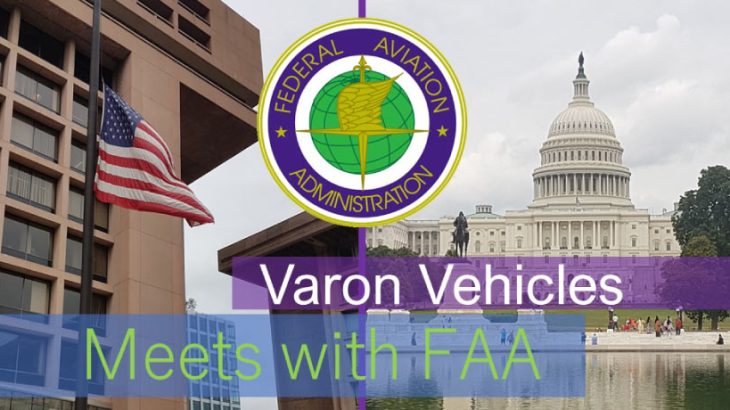
Varon Vehicles has held a meeting with the Federal Aviation Administration (FAA) to oversee the path that follows in the certification efforts of its V200 series new type of aircraft or flying cars as they are commercially referred to. Present in the meeting were FAA Aircraft Certification Service officers, Unmanned Aerial Systems Integration officers, and the FAA’s Urban Air Mobility related officers. On the Varon Vehicles side was Felipe Varon, CEO of the company, and its aeronautical engineering team and aircraft manufacturing, regulations and certification experts. The meeting was held at the FAA headquarters in Washington D.C.
The Varon Vehicles V200 series new type of aircraft concept was discussed, along with the architecture for airspace integration and operating concept being developed by the company. The FAA reflected its interest in supporting the company in all ways possible. Technical details were shared about type certification, applicable FAR chapters, industry standards for production and FAA guidance.
It was agreed that more such meetings will be held as the company continues with the innovative development of its Urban Air Mobility transportation system.




The Aeronautics Authority of a non-disclosable country has assigned an airspace volume to Varon Vehicles to perform exercises of its flying cars Traffic Management System (TMS). According to known information, it is the first and only Urban Air Mobility Transportation Services Company to have been granted an airspace for this purpose.
Varon Vehicles has laid out a plan in conjunction with said Aeronautics Authority to perform exercises of virtual lane design, intersections orchestration, vertiports take off and landing, and other related flying cars traffic management exercises. The exercises will be done initially with small commercial drones and with scaled and unmanned V200 flying car prototypes. The plan is already undergoing its second phase of a multi-year roadmap that involves the later expansion of the assigned airspace volume and involvement of real sized, manned V200 flying cars. It also involves studies and drawings of first airspace volumes over a real city and its surroundings where Varon Vehicles is working to implement its Test UAM Transportation System. These will follow Urban Geodesics, which is what Varon Vehicles calls the shortest path between two vertiports taking into account the city’s no fly zones, existing low altitude aeronautics routes, topography, obstacles and known climate conditions. Varon Vehicle’s Urban Geodesics are confined to Class G airspace, maintaining a ceiling of operation of no more than 400ft AGL, as part of the company’s strategy to break the customer’s fear of flight.
This airspace assignment constitutes a major milestone for the company and for the country where this work is being done. It sets a very significant precedent as Varon Vehicle’s proposed transportation system overcomes long established aeronautics paradigms to be able to reach urban environments to service city customers.

In November 2018 Varon Vehicles was invited to participate in an MIT roundtable where a diverse group of industry experts from academia, logistics companies, manufacturers, retailers and solutions providers gathered at MIT’s Center for Transportation & Logistics to discuss the future of retail. The attendees explored the changing needs of consumers, the dramatic decline in bricks-and-mortar retailing in the face of booming e-commerce sales and shifting consumer buying patterns and preferences. Dense urban centers are a major limiting logistical factor for supply chains.
Interesting points of discussion included how radically disruptive V200 Urban Air Mobility backed supply chains can help solve imperative logistics problems in dense urban centers, deliver freshness, how a vertical integration of our flying cars transportation systems can facilitate a way to manufacture products farther from consumption to help reduce operational costs, how it can assist in the proliferation of dark stores – a store that only fulfills online orders and is not open to the public, and other visionary benefits of the transportation of goods and courier via fleets of V200 flying cars routed over cities and suburbs. It is of interest to Varon Vehicles to engage with retail companies present in trend-setting cities such as Los Angeles, New York City, Paris and Shanghai.
Signals of the arrival of new business opportunities to the changing and mutating retail world is evident. Logistics, commercial and other related companies need to anticipate emerging needs, preferences and new channels of fulfillment and be proactive in meeting and adapting to them. The intention of Varon Vehicles is to establish transportation systems that have positive impacts both in supply chain business cases and in lifestyle by providing a new way of fast and convenient transportation for both courier and people.